


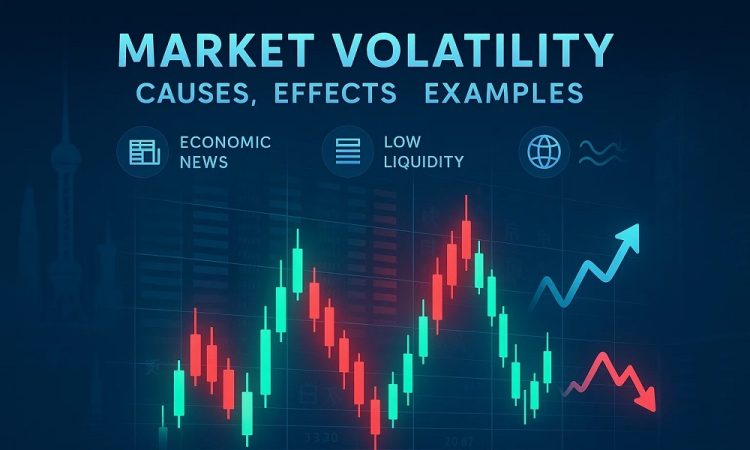
Market volatility is the engine of active trading. Without price movement, the financial markets offer no capital appreciation for short-term participants and limited opportunities for tactical asset reallocations. Volatility measures the rate and magnitude of price fluctuations of an asset over a given timeframe. Rather than being a static condition, volatility shifts across continuous market cycles, driven by macroeconomic releases, geopolitical events, liquidity fluctuations, and changing investor sentiment.
For short-term day traders, swing traders, and derivative specialists, volatility serves as both a primary catalyst for profit and a critical risk factor. A market with wide price swings provides rapid opportunities to enter and exit positions for substantial gains. However, when volatility rises without a structured trading framework, the increased speed and magnitude of market moves can quickly compound losses, widen transaction costs, and trigger unintended stop-out events. Understanding how volatility behaves, how it shapes market microstructure, and how to calibrate trading strategies to different volatility regimes is essential for navigating modern financial markets.
The Mechanics of Volatility: Historical Versus Implied
To exploit trading opportunities effectively, market participants must distinguish between the two primary classifications of volatility: historical volatility and implied volatility.
-
Historical Volatility: This metric reflects the actual statistical dispersion of past asset prices over a specific lookback window, such as twenty, thirty, or ninety trading days. Calculated using standard deviation, historical volatility reveals how erratic or steady an asset price has been in the recent past, providing a baseline for normal price behavior.
-
Implied Volatility: Unlike backward-looking historical measures, implied volatility is forward-looking and derived directly from options pricing models, such as the Black-Scholes formula. It represents the market consensus regarding the expected magnitude of future price movements over the lifespan of an option contract.
When implied volatility diverges significantly from historical volatility, specialized arbitrage and premium-selling opportunities emerge across derivative markets.
How High Volatility Expands Trading Opportunities
High-volatility environments occur when market participants rapidly reprice assets in response to breaking news, economic data surprises, earnings reports, or systemic macro shifts. These environments transform market behavior in several distinct ways.
Expanded Intraday Price Ranges
During calm market regimes, an instrument might trade within a narrow range throughout the session, limiting profit potential for intraday participants. When volatility surges, the Average True Range expands substantially.
-
A currency pair or stock that typically moves fifty pips or two dollars in a day may suddenly move two hundred pips or ten dollars.
-
Day traders and scalpers can achieve their target profit objectives in minutes rather than hours, reducing the amount of time capital is exposed to market risk.
-
Larger swings allow swing traders to capture multi-week price targets within a compressed multi-day window.
Clear Directional Momentum and Breakouts
High volatility often breaks persistent consolidation patterns. When heavy institutional volume hits the order book, key support and resistance zones are cleared with decisive momentum.
-
Breakout traders find high-probability setups when prices break out of multi-week chart patterns with expanding volume.
-
Trend-following algorithms and momentum traders benefit from extended directional runs, as institutional buying or selling creates strong multi-session trends with minimal pullbacks.
Elevated Derivative Premiums for Options Traders
In derivative markets, high implied volatility inflates option contract prices across all strike prices because option sellers demand higher compensation for taking on elevated risk.
-
Volatility sellers capitalize on elevated premiums by writing options strategies such as credit spreads, cash-secured puts, iron condors, and covered strangles.
-
Once the catalyst event passes—such as an earnings release or central bank rate decision—implied volatility drops sharply, allowing options sellers to buy back contracts at significant discounts, a phenomenon known as volatility crush.
Mean-Reversion Spikes at Extreme Boundaries
When market participants panic or engage in speculative euphoria, asset prices frequently overshoot their fair intrinsic value and push far beyond standard statistical boundaries.
-
Contrarian traders identify overextended conditions using technical indicators such as Bollinger Bands, the Relative Strength Index, or Keltner Channels.
-
Once institutional selling or buying volume exhausts itself, sharp mean-reversion bounces occur, offering attractive asymmetric risk-to-reward setups for traders stepping in at extreme exhaustion points.
Operational Risks and Frictions in High-Volatility Markets
While elevated volatility creates fertile ground for profitable trades, it also introduces operational friction that can compromise standard risk management protocols.
-
Slippage on Order Execution: Fast-moving markets often create order book imbalances where the volume of market orders exhausts available limit orders at specific price levels. Traders attempting to buy or sell at market prices may experience negative slippage, filling orders several ticks or pips away from their intended levels.
-
Bid-Ask Spread Widening: Liquidity providers and market-making algorithms protect themselves from adverse price movements during volatile conditions by widening the bid-ask spread. Wider spreads increase the transaction cost of entering and exiting positions, making frequent scalping less cost-effective.
-
False Breakouts and Whipsaws: Rapid price expansion can produce sudden head-fakes where prices briefly spike beyond key support or resistance levels to sweep resting liquidity before reversing violently in the opposite direction.
-
Margin and Leverage Adjustments: Brokerage firms frequently increase maintenance margin requirements during periods of extreme market turbulence to protect their clearing operations from client defaults, reducing available leverage for traders.
Trading in Low-Volatility Environments
When volatility contracts, price action shifts from aggressive trends to tight consolidations and low-volume drift. While low-volatility regimes offer fewer large momentum opportunities, they present alternative trading environments that require distinct tactical playbooks.
Range-Bound and Grid Trading
During extended periods of low volatility, price movements are heavily contained between well-defined support and resistance levels.
-
Mean-reversion strategies become highly effective, allowing traders to sell at the top of established ranges and buy at the bottom.
-
Algorithmic grid systems perform reliably in steady ranges, capturing small, consistent price fluctuations without the risk of severe trend breakouts.
Volatility Compression Breakout Preparation
Volatility is cyclical; prolonged periods of ultra-low volatility inevitably lead to explosive volatility expansion.
-
Technical indicators like the Bollinger Band Squeeze identify instruments where trading ranges have compressed to historical lows.
-
Strategic traders position for the coming expansion by placing bracket orders above and below the consolidation range or buying low-priced long options contracts that benefit from future volatility expansion.
Calibrating Trading Strategies Across Volatility Regimes
To navigate changing volatility conditions successfully, market participants must dynamically adjust their execution tactics, position sizing, and stop-loss parameters.
-
Implement Volatility-Adjusted Position Sizing: Rather than using a fixed share size or lot size, calculate trade volume based on the current Average True Range. When volatility is high, widen your stop loss to avoid getting stopped out by routine noise, and reduce your total position size to ensure the total dollar risk per trade remains constant.
-
Shorten Holding Periods During Extreme Swings: In high-volatility environments, take partial profits quickly at initial structural targets rather than waiting for extended trend continuation, protecting unrealized gains from violent pullbacks.
-
Select the Right Asset Class for Current Conditions: If currency markets enter low-volatility consolidation while equity indices or commodities experience heavy volatility, rotate active capital toward the asset classes demonstrating the highest relative volume and price expansion.
Frequently Asked Questions
How does the Chicago Board Options Exchange Volatility Index relate to equity market direction?
The Chicago Board Options Exchange Volatility Index, commonly known as the VIX, measures thirty-day expected volatility derived from Standard and Poor 500 index options. Historically, the VIX exhibits an inverse correlation with equity prices. When stock markets drop rapidly, fear rises, demand for downside put options surges, and the VIX spikes. Conversely, during steady, grind-up bull markets, the VIX typically declines to lower levels as market complacency increases.
What is volatility clustering and why is it important for trade timing?
Volatility clustering is a well-documented financial phenomenon where large price movements are followed by further large movements, and small price movements are followed by further small movements. For traders, this means that once a high-volatility event begins, elevated price swings tend to persist across multiple consecutive trading sessions rather than resolving instantly, signaling that momentum-based strategies will likely remain viable over the short term.
Can high market volatility cause gaps that bypass standard stop-loss orders?
Yes. A standard stop-loss order becomes an active market order only after the stop price is triggered. If the market experiences a severe liquidity vacuum, flash crash, or weekend opening gap where prices jump over your stop-loss level, the order is filled at the next available market price, which may be significantly worse than your specified level. To prevent this, traders can utilize guaranteed stop-loss orders where offered by brokers or reduce position sizes ahead of high-risk events.
How does implied volatility crush affect options traders around major earnings announcements?
Prior to a corporate earnings release, implied volatility rises significantly because market participants anticipate a substantial price move, driving up the price of both call and put options. Immediately after the earnings report is released and the uncertainty is resolved, implied volatility drops sharply back to normal levels. This sudden collapse in option premiums, known as implied volatility crush, often causes purchased options to lose value rapidly even if the underlying stock moves in the expected direction.
Why do central bank interest rate announcements trigger sudden volatility spikes?
Central bank rate announcements and monetary policy statements establish sovereign borrowing costs and influence global capital flows. When a central bank shifts interest rates or delivers a monetary policy statement that surprises market expectations, institutional asset managers must instantly reprice currency pairs, bond yields, and equity valuations simultaneously. This rapid reallocation of capital produces massive order volume, rapid order book shifts, and immediate volatility spikes across multiple asset classes.
Is higher market volatility always better for short-term day traders?
Not necessarily. While higher volatility provides larger intraday price targets, it also increases execution risk through wider bid-ask spreads, higher slippage, and violent whipsaws. Optimal trading conditions for many short-term day traders occur during moderate-to-high, clean directional volatility with deep market liquidity, rather than during erratic, low-liquidity volatility spikes where technical levels are easily overrun.
How do institutional market makers adjust their quotes during extreme volatility events?
Institutional market makers adjust their operations during extreme volatility by widening their posted bid-ask spreads and reducing the quoted order size available at each price level in the order book. By pulling liquidity further away from the inside market, market-making algorithms protect their capital from adverse selection and toxic institutional order flow, which in turn causes wider spreads and increased slippage for retail market orders.


